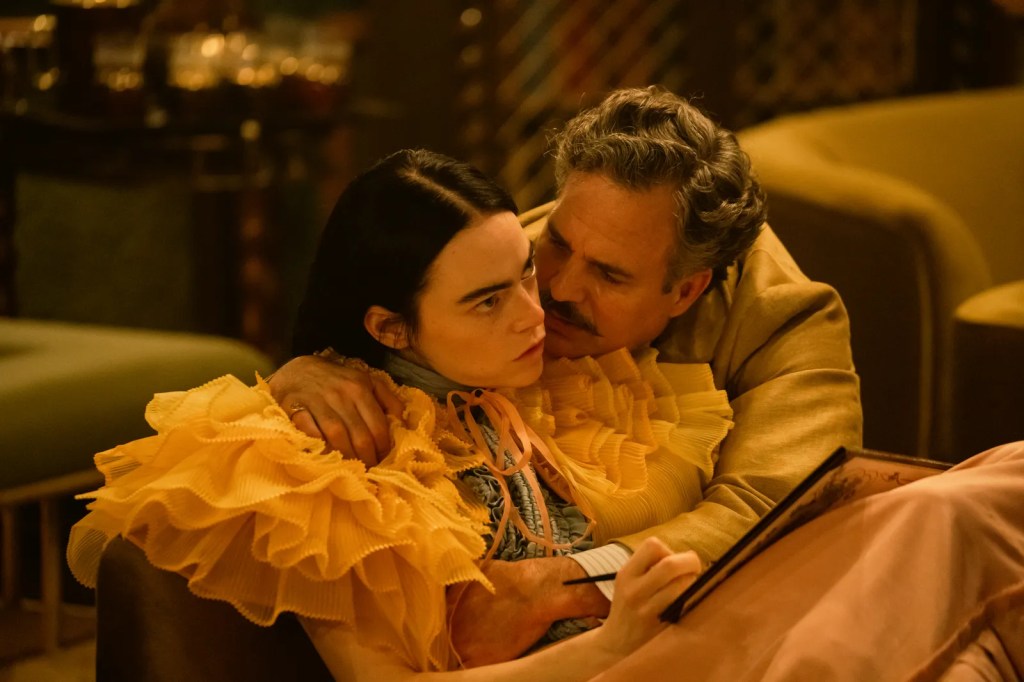
When Tony McNamara began adapting Alasdair Grey’s surrealist tale of a Victorian heroine with a baby’s brain, Vanity Fair reports he “quickly noticed that the story was told from the perspective of the men who come into and out of the main character’s life, not from Bella Baxter herself”. Lanthimos and McNamara decided – the good male allies they are – to give baby Bella Baxter a gurgling, burgeoning voice.
“Poor Things Reverts The “Male Gaze”. “Poor Things Calls For Socialist Feminism By Challenging Status Quo”. “Poor Things review: A Gloriously Wild Feminist Odyssey”. Patti Smith, punk icon, uploaded to the gram a snap of a black coffee accessorised with an orange Poor Things purse. “So much wisdom”, “Wonderfully insightful” female followers commented. Move aside Barbie, take your sugary sweet girl-power with you: Poor Things is the provocative feminist opus of our times.

Or is it? It’s hard to believe that a film with details like moulded brass clitoris light switches, that early on in the film, when Bella Baxter – whose hair “grows an inch every two days” – outstretches her adult female body on the sumptuous bed, that her hairless armpits and legs are an oversight.

Poor Things won the BAFTA Make-Up & Hair category
Suspended in Lathimos’ steampunk reality, I fell to the ground with a bump. Who is shaving her? The maid? God, I wish my skin looked so nick-less and smooth considering I’m not thrashing about in the shower. Some Victorian women did shave, true. But then again why would an a-sexual scientist be concerned with such trivialities when a) she is barred from polite society and b) she is supposedly an object of science, not sex? I looked about me in the packed cinema, was anybody else’s mind chattering like Quentin Tarantino on coke?
So later, I was whip-lashed by Bella’s “hairy parts” (as the film refers to the vulva) which were indeed, hairy. What’s going on here? ‘Bushes are sexy now, armpit hair isn’t’ a friend later explains via WhatsApp. Five minutes on a porn site will prove her point.
And, maybe because this is so normalised in cinema, I hadn’t even noticed until I scrolled Reddit, that our heroine never has a period. Damn Yorgos, wouldn’t a period-sex scene – Bella Baxter entirely unfettered – have underlined in sharpie the sex-positive point you’re trying to make?
Like Defoe’s janky Scottish accent, I’m going to grant these issues a pass. Perhaps this is all because of an immature pituitary gland. Perhaps, they worried about being ‘too much’, in the same way that Barbie (in the best way possible) was like a home foot spa for those dipping their toes into feminism. But, there are parts of the film that are less easy to dismiss– and think none of us should: ‘‘polite society” or not.
In all the conversations I’ve had with female friends about washing machines, electric toothbrushes, and showerheads, I’ve never heard of someone sticking breakfast items up themselves 24 hours after first paddling the pink canoe. Typically, “giving yourself happiness” does not revolve around penetration (and especially not before being told –YUCK!– the context for that four-syllable word).

This isn’t another hiccup, this is the maggot writhing inside this shiny apple. The male gaze which inserts itself into a child’s budding sexuality.
There are several seat-squirming moments: like when asked whether Bella is Defoe’s “sex slave”, “God” rambles – to comedic effect– about how fucking her could kill him … with a footnote about his “paternal” feelings. Or the moment when blowing bubbles inside a cabinet, Mark Ruffolo, a stranger, gropes her.
These men have power complexes, fine, but the real gut-twister was when this is what a feminist looks like Max falls passionately in love with Bella. “She is …stunning.” he gasps, whilst Bella gurgles “weeee” and pisses herself. We are encouraged to sympathise for Max, who, despite his urges, politely pops unconscious Bella’s tit away. “You are adorable. You always were”, Bella says, proposing to him later on – the same dweeb who has the hots for un-potty trained babies. Here you go ladies, the film generously offers, yes, men are quite pathetic, but good guys are real!!
Thanks, I guess?
Of course, the ‘sexy-baby’ on screen isn’t anything new. Threatened by the growing female workforce, and the shifting gender dynamics that came with it, men arriving back from war lapped up Marilyn Monroe’s helpless, childlike sensuality. And just like that, the shining heroines of Cinema’s Golden-Age (think Marlene Dietrich, Katherine Hepburn or Joan Crawford) became increasingly dim.


But sexy-baby Bella has agency, right? Yorgos’ sexy-baby rattles this trope by a) never allowing her sexuality to be malleable by men b) evolving into a classical, leading lady. Despite being a child, a captive, a sex-worker, Bella is completely un-expolitable.

Iconic! Well, no, not really: unrealistic and dangerously so.
‘Mature for her age’, ‘Precocious’ , ‘Knew what she wanted’, ‘Instigator’. These are phrases you could use to describe Bella Baxter, or hear a defence attorney argue in court. I will avoid using the scary, loaded words here, words that have been thrashed over news forums, and in memes about Stephen Hawking. Acting-upon attraction to children isn’t only ‘bad’ because it’s an attraction to the under-developed body. What is really dangerous, and what destroys lives, is taking sexual advantage of an under-developed mind.
Recently, in an interview actress Sydney Sweeney – Euphoria, Anyone But You – ‘got off her chest’ (inspired journalism there) her own experience with puberty. “When your body becomes sexualized as a child you can start to hate it and blame yourself.” I saw this retweeted with a pointer towards the book Poet X by Elizabeth Acevedo. Acevedo, in her novels for young adults, explores how when girls hit puberty, society steals their childhoods from them – especially for women of colour, whose bodies are readily objectified and sexualised.


The truth is, that having a developed body before a developed mind is not a surrealist fantasy about one, white, sheltered woman, but the lived experience of millions. The idea that a child ‘furious jumping’ with adult men, and it only being a sexually affirming experience is the greater fantasy. If this were true, then the suicide rate of child sex abuse victims wouldn’t be 10.7 – 13 times higher than their peers. Grooming isn’t about making the sexless child sexual, it’s about exploiting someone who isn’t ready to handle their sexual urges safely.
 Alice Gee